1.在直线$m$上依次取互不重合的三个点$D,A,E$,在直线$m$上方有$AB=AC$,且满足$∠ BDA=∠ AEC=∠ BAC=α$.
(1)如图①,当$α=90°$时,线段$DE,BD,CE$之间的数量关系是________.
(2)如图②,当$0°<α<180°$时,(1)中结论是否仍然成立? 若成立,请给出证明;若不成立,请说明理由.
(3)拓展与应用:如图③,当$α=120°$时,$F$为$∠ BAC$平分线上的一点,且$AB=AF$,分别连接$FB,FD,FE,FC$,试判断$△ DEF$的形状,并说明理由.
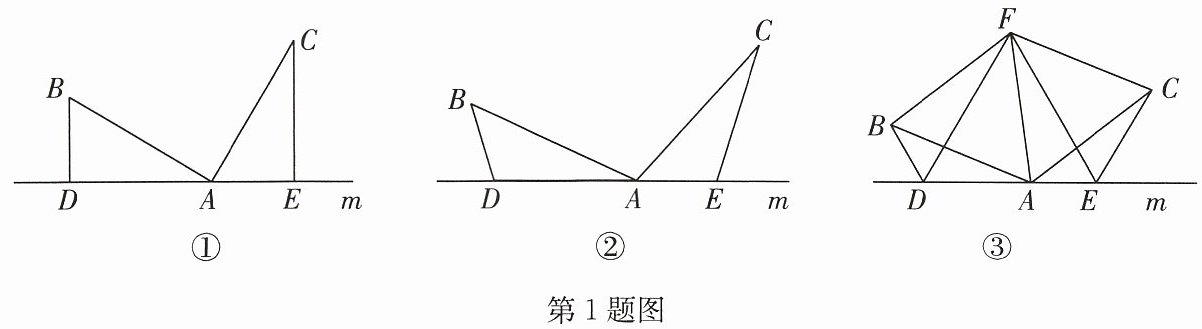
(1)如图①,当$α=90°$时,线段$DE,BD,CE$之间的数量关系是________.
(2)如图②,当$0°<α<180°$时,(1)中结论是否仍然成立? 若成立,请给出证明;若不成立,请说明理由.
(3)拓展与应用:如图③,当$α=120°$时,$F$为$∠ BAC$平分线上的一点,且$AB=AF$,分别连接$FB,FD,FE,FC$,试判断$△ DEF$的形状,并说明理由.
答案:1.(1)$DE=BD+CE$
(2)解:$DE=BD+CE$仍然成立.
证明:$\because ∠ BDA=∠ BAC=∠ AEC=α$,
$\therefore ∠ BAD+∠ EAC=∠ BAD+∠ DBA=180°-α$,
$\therefore ∠ DBA=∠ EAC. \because AB=CA$,
$\therefore △ DBA≌ △ EAC(\mathrm{AAS}), \therefore BD=AE, AD=CE$,
$\therefore DE=AD+AE=BD+CE$.
(3)解:$△ DEF$是等边三角形.理由如下:
$\because α=120°$,AF平分$∠ BAC$,$\therefore ∠ BAF=∠ CAF=60°$.
$\because AB=AF=AC$,$\therefore △ ABF$和$△ ACF$都是等边三角形,
$\therefore FA=FC, ∠ FCA=∠ FAB=∠ AFC=60°$,
同(2)可得,$△ BDA≌ △ AEC$,
$\therefore ∠ BAD=∠ ACE. AD=CE$,
$\therefore ∠ FAD=∠ FCE, \therefore △ FAD≌ △ FCE(\mathrm{SAS})$,
$\therefore DF=EF, ∠ DFA=∠ EFC$,
$\therefore ∠ DFE = ∠ DFA + ∠ AFE = ∠ EFC + ∠ AFE = ∠ AFC=60°$,$\therefore △ DEF$是等边三角形.
(2)解:$DE=BD+CE$仍然成立.
证明:$\because ∠ BDA=∠ BAC=∠ AEC=α$,
$\therefore ∠ BAD+∠ EAC=∠ BAD+∠ DBA=180°-α$,
$\therefore ∠ DBA=∠ EAC. \because AB=CA$,
$\therefore △ DBA≌ △ EAC(\mathrm{AAS}), \therefore BD=AE, AD=CE$,
$\therefore DE=AD+AE=BD+CE$.
(3)解:$△ DEF$是等边三角形.理由如下:
$\because α=120°$,AF平分$∠ BAC$,$\therefore ∠ BAF=∠ CAF=60°$.
$\because AB=AF=AC$,$\therefore △ ABF$和$△ ACF$都是等边三角形,
$\therefore FA=FC, ∠ FCA=∠ FAB=∠ AFC=60°$,
同(2)可得,$△ BDA≌ △ AEC$,
$\therefore ∠ BAD=∠ ACE. AD=CE$,
$\therefore ∠ FAD=∠ FCE, \therefore △ FAD≌ △ FCE(\mathrm{SAS})$,
$\therefore DF=EF, ∠ DFA=∠ EFC$,
$\therefore ∠ DFE = ∠ DFA + ∠ AFE = ∠ EFC + ∠ AFE = ∠ AFC=60°$,$\therefore △ DEF$是等边三角形.
解析:
【分析】
(1) 当$α=90°$时,$∠ BDA$、$∠ AEC$、$∠ BAC$均为直角,根据同角的余角相等可推出$∠ DBA=∠ EAC$,结合$AB=AC$即可证明$△ DBA≌△ EAC$,将对应边等量代换后就能得到$DE$、$BD$、$CE$的数量关系。
(2) 对于$0°<α<180°$的一般情况,思路与(1)一致:利用三角形内角和与平角的性质,可推出$∠ DBA=∠ EAC$,再通过AAS证明$△ DBA≌△ EAC$,转化对应边即可验证(1)的结论是否成立。
(3) 首先根据$α=120°$、$AF$平分$∠ BAC$且$AB=AF=AC$,可证$△ ABF$和$△ ACF$都是等边三角形,得到边、角的等量关系;再沿用(2)的全等结论,推导得到$∠ FAD=∠ FCE$,通过SAS证明$△ FAD≌△ FCE$,可得$DF=EF$且$∠ DFE=60°$,即可判断$△ DEF$的形状。
【解析】
(1) 当$α=90°$时,$∠ BDA=∠ BAC=∠ AEC=90°$,
$\therefore ∠ BAD+∠ DBA=90°$,$∠ BAD+∠ EAC=90°$,
$\therefore ∠ DBA=∠ EAC$,
又$\because AB=AC$,
$\therefore △ DBA≌△ EAC(\mathrm{AAS})$,
$\therefore BD=AE$,$AD=CE$,
$\therefore DE=AD+AE=BD+CE$。
(2) $DE=BD+CE$仍然成立,证明如下:
$\because ∠ BDA=∠ BAC=∠ AEC=α$,
$\therefore ∠ BAD+∠ EAC=∠ BAD+∠ DBA=180°-α$,
$\therefore ∠ DBA=∠ EAC$,
$\because AB=CA$,
$\therefore △ DBA≌△ EAC(\mathrm{AAS})$,
$\therefore BD=AE$,$AD=CE$,
$\therefore DE=AD+AE=BD+CE$。
(3) $△ DEF$是等边三角形,理由如下:
$\because α=120°$,$AF$平分$∠ BAC$,
$\therefore ∠ BAF=∠ CAF=60°$,
$\because AB=AF=AC$,
$\therefore △ ABF$和$△ ACF$都是等边三角形,
$\therefore FA=FC$,$∠ FCA=∠ FAB=∠ AFC=60°$,
同(2)可得,$△ BDA≌△ AEC$,
$\therefore ∠ BAD=∠ ACE$,$AD=CE$,
$\therefore ∠ FAD=∠ FAB+∠ BAD=60°+∠ BAD$,$∠ FCE=∠ FCA+∠ ACE=60°+∠ ACE$,
$\therefore ∠ FAD=∠ FCE$,
$\therefore △ FAD≌△ FCE(\mathrm{SAS})$,
$\therefore DF=EF$,$∠ DFA=∠ EFC$,
$\therefore ∠ DFE=∠ DFA+∠ AFE=∠ EFC+∠ AFE=∠ AFC=60°$,
$\therefore △ DEF$是等边三角形。
【答案】
(1)$DE=BD+CE$
(2)$DE=BD+CE$仍然成立,证明见解析
(3)$△ DEF$是等边三角形,理由见解析
【知识点】
一线三等角模型、全等三角形的判定与性质、等边三角形的判定
【点评】
本题围绕“一线三等角”全等模型递进设问,从特殊角度到一般角度推导共性结论,最后拓展应用结论判断特殊三角形,既考察了全等三角形的证明和性质应用,也考察了等边三角形的判定,解题时可通过类比迁移,找到不同条件下不变的边角等量关系即可求解。
【难度系数】
0.6
(1) 当$α=90°$时,$∠ BDA$、$∠ AEC$、$∠ BAC$均为直角,根据同角的余角相等可推出$∠ DBA=∠ EAC$,结合$AB=AC$即可证明$△ DBA≌△ EAC$,将对应边等量代换后就能得到$DE$、$BD$、$CE$的数量关系。
(2) 对于$0°<α<180°$的一般情况,思路与(1)一致:利用三角形内角和与平角的性质,可推出$∠ DBA=∠ EAC$,再通过AAS证明$△ DBA≌△ EAC$,转化对应边即可验证(1)的结论是否成立。
(3) 首先根据$α=120°$、$AF$平分$∠ BAC$且$AB=AF=AC$,可证$△ ABF$和$△ ACF$都是等边三角形,得到边、角的等量关系;再沿用(2)的全等结论,推导得到$∠ FAD=∠ FCE$,通过SAS证明$△ FAD≌△ FCE$,可得$DF=EF$且$∠ DFE=60°$,即可判断$△ DEF$的形状。
【解析】
(1) 当$α=90°$时,$∠ BDA=∠ BAC=∠ AEC=90°$,
$\therefore ∠ BAD+∠ DBA=90°$,$∠ BAD+∠ EAC=90°$,
$\therefore ∠ DBA=∠ EAC$,
又$\because AB=AC$,
$\therefore △ DBA≌△ EAC(\mathrm{AAS})$,
$\therefore BD=AE$,$AD=CE$,
$\therefore DE=AD+AE=BD+CE$。
(2) $DE=BD+CE$仍然成立,证明如下:
$\because ∠ BDA=∠ BAC=∠ AEC=α$,
$\therefore ∠ BAD+∠ EAC=∠ BAD+∠ DBA=180°-α$,
$\therefore ∠ DBA=∠ EAC$,
$\because AB=CA$,
$\therefore △ DBA≌△ EAC(\mathrm{AAS})$,
$\therefore BD=AE$,$AD=CE$,
$\therefore DE=AD+AE=BD+CE$。
(3) $△ DEF$是等边三角形,理由如下:
$\because α=120°$,$AF$平分$∠ BAC$,
$\therefore ∠ BAF=∠ CAF=60°$,
$\because AB=AF=AC$,
$\therefore △ ABF$和$△ ACF$都是等边三角形,
$\therefore FA=FC$,$∠ FCA=∠ FAB=∠ AFC=60°$,
同(2)可得,$△ BDA≌△ AEC$,
$\therefore ∠ BAD=∠ ACE$,$AD=CE$,
$\therefore ∠ FAD=∠ FAB+∠ BAD=60°+∠ BAD$,$∠ FCE=∠ FCA+∠ ACE=60°+∠ ACE$,
$\therefore ∠ FAD=∠ FCE$,
$\therefore △ FAD≌△ FCE(\mathrm{SAS})$,
$\therefore DF=EF$,$∠ DFA=∠ EFC$,
$\therefore ∠ DFE=∠ DFA+∠ AFE=∠ EFC+∠ AFE=∠ AFC=60°$,
$\therefore △ DEF$是等边三角形。
【答案】
(1)$DE=BD+CE$
(2)$DE=BD+CE$仍然成立,证明见解析
(3)$△ DEF$是等边三角形,理由见解析
【知识点】
一线三等角模型、全等三角形的判定与性质、等边三角形的判定
【点评】
本题围绕“一线三等角”全等模型递进设问,从特殊角度到一般角度推导共性结论,最后拓展应用结论判断特殊三角形,既考察了全等三角形的证明和性质应用,也考察了等边三角形的判定,解题时可通过类比迁移,找到不同条件下不变的边角等量关系即可求解。
【难度系数】
0.6