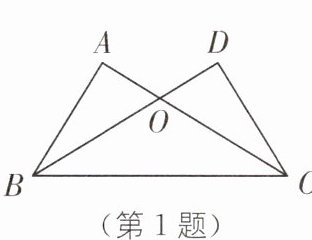
1.(2025·浙江杭州开元中学期中)如图,下列条件不能证明$△ ABC ≌ △ DCB$的是(
A.$AB=DC,AC=DB$
B.$AB=DC,∠ ABC=∠ DCB$
C.$BO=CO,∠ A=∠ D$
D.$AC=BD,∠ A=∠ D$
D
).A.$AB=DC,AC=DB$
B.$AB=DC,∠ ABC=∠ DCB$
C.$BO=CO,∠ A=∠ D$
D.$AC=BD,∠ A=∠ D$
答案:1.D [解析]A. $AB=DC,AC=DB,BC=BC$,符合全等三角形的判定定理“SSS”,即能推出$△ABC≌△DCB$,故本选项不符合题意;B. $AB=DC,∠ABC=∠DCB,BC=BC$,符合全等三角形的判定定理“SAS”,即能推出$△ABC≌△DCB$,故本选项不符合题意;
C. 在$△AOB$ 和$△DOC$ 中,$\begin{cases} ∠AOB=∠DOC, \\ ∠A=∠D, \\ OB=OC, \end{cases}$
$\therefore △AOB≌△DOC(\mathrm{AAS}),$
$\therefore AB=DC,∠ABO=∠DCO,$
$\because OB=OC,\therefore ∠OBC=∠OCB,$
$\therefore ∠ABC=∠DCB,$
在$△ABC$ 和$△DCB$ 中,$\begin{cases} AB=DC, \\ ∠ABC=∠DCB, \\ BC=CB, \end{cases}$
$\therefore △ABC≌△DCB(\mathrm{SAS}),$
即能推出$△ABC≌△DCB$,故本选项不符合题意;
D. 具备条件 $AC=DB,BC=BC,∠A=∠D$ 不能推出$△ABC≌△DCB$,故本选项符合题意. 故选 D.
C. 在$△AOB$ 和$△DOC$ 中,$\begin{cases} ∠AOB=∠DOC, \\ ∠A=∠D, \\ OB=OC, \end{cases}$
$\therefore △AOB≌△DOC(\mathrm{AAS}),$
$\therefore AB=DC,∠ABO=∠DCO,$
$\because OB=OC,\therefore ∠OBC=∠OCB,$
$\therefore ∠ABC=∠DCB,$
在$△ABC$ 和$△DCB$ 中,$\begin{cases} AB=DC, \\ ∠ABC=∠DCB, \\ BC=CB, \end{cases}$
$\therefore △ABC≌△DCB(\mathrm{SAS}),$
即能推出$△ABC≌△DCB$,故本选项不符合题意;
D. 具备条件 $AC=DB,BC=BC,∠A=∠D$ 不能推出$△ABC≌△DCB$,故本选项符合题意. 故选 D.
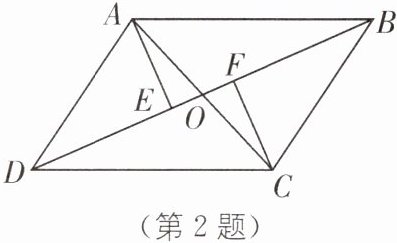
2.(2025·无锡宜兴期末)如图,已知$AB// CD$,$AD// BC$,$AC$与$BD$交于点$O$,$AE⊥ BD$于点$E$,$CF⊥ BD$于点$F$,那么图中全等的三角形有(
A.5对
B.6对
C.7对
D.8对
C
)。A.5对
B.6对
C.7对
D.8对
答案:2.C [解析]由题可知$△ABD≌△CDB$,$△ABO≌△CDO$,$△ADE≌△CBF$,$△AOE≌△COF$,$△AOD≌△COB$,$△ABC≌△CDA$,$△ABE≌△CDF$,共7对. 故选 C.
3. 如图,有一池塘,要测池塘两端A,B的距离,可先在平地上取一个点C,从点C不经过池塘可以直接到达点A和B,连接AC并延长到点D,使$CD=CA$,连接BC并延长到点E,使$CE=CB$,连接DE,那么量出DE的长就是A,B的距离,为什么?
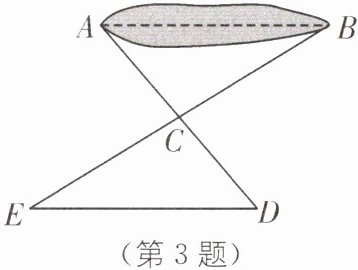
请结合解题过程,完成本题的证明.
证明:在$△ DEC$和$△ ABC$中,
$\begin{cases} CD=\_\_\_\_\_\_, \\ \_\_\_\_\_\_, \\ CE=\_\_\_\_\_\_, \end{cases}$
$\therefore △ DEC ≌ △ ABC(\mathrm{SAS}),$
$\therefore \_\_\_\_\_\_.$
请结合解题过程,完成本题的证明.
证明:在$△ DEC$和$△ ABC$中,
$\begin{cases} CD=\_\_\_\_\_\_, \\ \_\_\_\_\_\_, \\ CE=\_\_\_\_\_\_, \end{cases}$
$\therefore △ DEC ≌ △ ABC(\mathrm{SAS}),$
$\therefore \_\_\_\_\_\_.$
答案:3. CA $∠DCE=∠ACB$ CB $DE=AB$
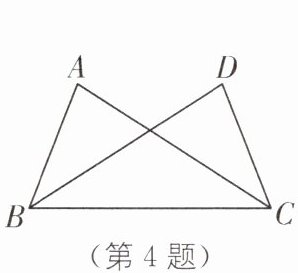
4. 教材P30习题T2·变式 如图,在$△ ABC$和$△ DCB$中,$∠ ACB=∠ DBC$,添加一个条件,不能证明$△ ABC$和$△ DCB$全等的是(
A.$∠ ABC=∠ DCB$
B.$AB=DC$
C.$AC=DB$
D.$∠ A=∠ D$
 (第4题)
(第4题)
B
).A.$∠ ABC=∠ DCB$
B.$AB=DC$
C.$AC=DB$
D.$∠ A=∠ D$
(第4题)答案:4.B
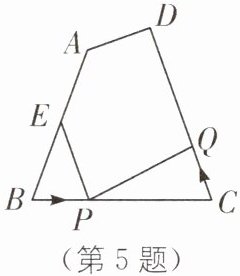
5. 分类讨论思想(2026·广西崇左江州区期末)如图,已知在四边形ABCD中,AB=12 cm,BC=8 cm,CD=14 cm,∠B=∠C,E为线段AB的中点,点P在线段BC上以3 cm/s的速度由点B向点C运动,同时点Q在线段CD上由点C向点D运动。要使△BPE与△CPQ全等,点Q的运动速度为(
A.3 cm/s
B.4 cm/s
C.2 cm/s或4.5 cm/s
D.3 cm/s或4.5 cm/s
D
)。A.3 cm/s
B.4 cm/s
C.2 cm/s或4.5 cm/s
D.3 cm/s或4.5 cm/s
答案:5.D [解析]设运动时间为$t$秒,点 Q 的运动速度是$v$ cm/s,则 $BP=3t$ cm,$CQ=vt$ cm,$CP=(8-3t)$ cm.
$\because E$ 为 $AB$ 的中点,$AB=12$ cm,$\therefore BE=AE=6$ cm.
$\because ∠B=∠C$,$\therefore$ 要使$△BPE$ 与$△CPQ$ 全等,必须 $BE=CP$,$BP=CQ$ 或 $BE=CQ$,$BP=CP$.
当 $BE=CP$,$BP=CQ$ 时,$6=8-3t$,$3t=vt$,
解得 $t=\frac{2}{3}$,$v=3$,即点 Q 的运动速度是 3 cm/s;
当 $BE=CQ$,$BP=CP$ 时,$6=vt$,$3t=8-3t$,
解得 $t=\frac{4}{3}$,$v=4.5$,即点 Q 的运动速度是 4.5 cm/s.
综合上述,当点 Q 的运动速度为 3 cm/s 或 4.5 cm/s 时,能够使$△BPE$ 与$△CPQ$ 全等. 故选 D.
$\because E$ 为 $AB$ 的中点,$AB=12$ cm,$\therefore BE=AE=6$ cm.
$\because ∠B=∠C$,$\therefore$ 要使$△BPE$ 与$△CPQ$ 全等,必须 $BE=CP$,$BP=CQ$ 或 $BE=CQ$,$BP=CP$.
当 $BE=CP$,$BP=CQ$ 时,$6=8-3t$,$3t=vt$,
解得 $t=\frac{2}{3}$,$v=3$,即点 Q 的运动速度是 3 cm/s;
当 $BE=CQ$,$BP=CP$ 时,$6=vt$,$3t=8-3t$,
解得 $t=\frac{4}{3}$,$v=4.5$,即点 Q 的运动速度是 4.5 cm/s.
综合上述,当点 Q 的运动速度为 3 cm/s 或 4.5 cm/s 时,能够使$△BPE$ 与$△CPQ$ 全等. 故选 D.
6. (广东广州大学附中自主招生)在$△ ABC$中,高AD和高BE所在的直线相交于点F,且$BF=AC$,则$∠ ABC$的度数为
45°或135°
。答案:
6. 45°或135° [解析]①如图(1),当$△ABC$ 为锐角三角形时,$∠BAC$ 为锐角. $\because AD⊥BC$,$BE⊥AC$,$\therefore ∠BDF=∠ADC=∠BEC=90°$,
$\therefore ∠C+∠CBE=90°$,$∠C+∠CAD=90°$,$\therefore ∠CBF=∠CAD$.
在$△BDF$ 和$△ADC$ 中,$\begin{cases} ∠BDF=∠ADC, \\ ∠DBF=∠DAC, \\ BF=AC, \end{cases}$
$\therefore △BDF≌△ADC(\mathrm{AAS}),\therefore BD=AD,\therefore ∠ABD=45°$,即$∠ABC=45°$;
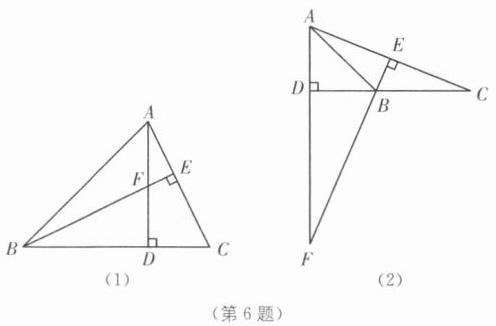
②如图(2),当$△ABC$ 为钝角三角形时,$∠ABC$ 为钝角,同理可证$△BDF≌△ADC(\mathrm{AAS}),\therefore BD=AD$,
$\therefore ∠ABD=45°,\therefore ∠ABC=135°$.
其他分类情况下的度数与以上重复.
综上所述,$∠ABC$ 的度数为$45°$或$135°$.
6. 45°或135° [解析]①如图(1),当$△ABC$ 为锐角三角形时,$∠BAC$ 为锐角. $\because AD⊥BC$,$BE⊥AC$,$\therefore ∠BDF=∠ADC=∠BEC=90°$,
$\therefore ∠C+∠CBE=90°$,$∠C+∠CAD=90°$,$\therefore ∠CBF=∠CAD$.
在$△BDF$ 和$△ADC$ 中,$\begin{cases} ∠BDF=∠ADC, \\ ∠DBF=∠DAC, \\ BF=AC, \end{cases}$
$\therefore △BDF≌△ADC(\mathrm{AAS}),\therefore BD=AD,\therefore ∠ABD=45°$,即$∠ABC=45°$;
②如图(2),当$△ABC$ 为钝角三角形时,$∠ABC$ 为钝角,同理可证$△BDF≌△ADC(\mathrm{AAS}),\therefore BD=AD$,
$\therefore ∠ABD=45°,\therefore ∠ABC=135°$.
其他分类情况下的度数与以上重复.
综上所述,$∠ABC$ 的度数为$45°$或$135°$.
7.(2025·南京玄武区期中)如图,点A,D,C,F在同一条直线上,BC//EF,BC=EF,AD=CF.求证:△ABC≌△DEF.
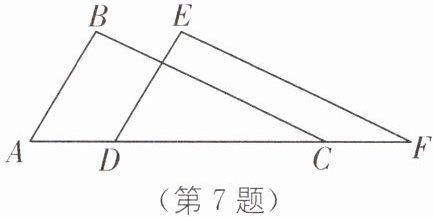
答案:7. $\because BC// EF,\therefore ∠ACB=∠F$.
$\because AD=CF,\therefore AD+DC=DC+CF$,即 $AC=DF$.
在$△ABC$ 和$△DEF$ 中,$\begin{cases} BC=EF, \\ ∠ACB=∠F, \\ AC=DF, \end{cases}$
$\therefore △ABC≌△DEF(\mathrm{SAS}).$
$\because AD=CF,\therefore AD+DC=DC+CF$,即 $AC=DF$.
在$△ABC$ 和$△DEF$ 中,$\begin{cases} BC=EF, \\ ∠ACB=∠F, \\ AC=DF, \end{cases}$
$\therefore △ABC≌△DEF(\mathrm{SAS}).$