1. 手拉手模型(2026·山东日照月考)在△ABC中,AB=AC,D是射线CB上的一动点(不与点B,C重合),以AD为一边在AD的右侧作△ADE,使AD=AE,∠DAE=∠BAC,连接CE.
(1)如图(1),当点D在线段CB上,且∠BAC=90°时,那么∠DCE=
(2)设∠BAC=α,∠DCE=β.
①如图(2),当点D在线段CB上,∠BAC≠90°时,请你探究α与β之间的数量关系,并证明你的结论;
②如图(3),当点D在线段CB的延长线上,∠BAC≠90°时,请将图(3)补充完整,写出此时α与β之间的数量关系并证明.
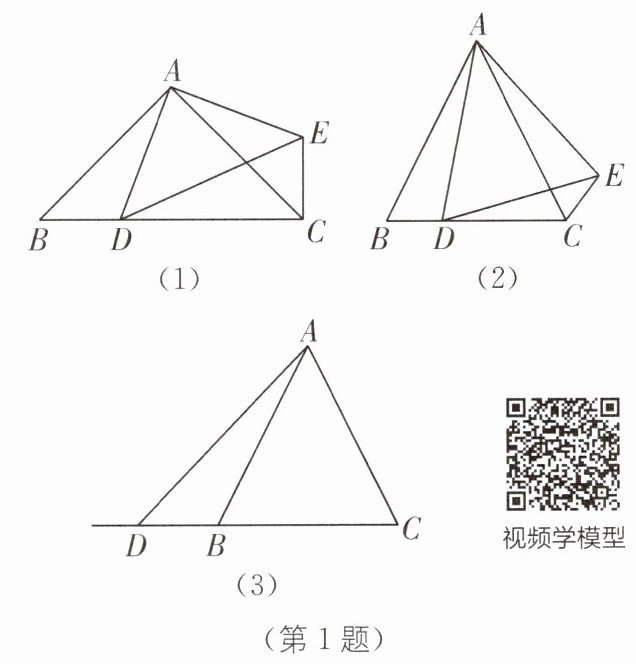
(1)如图(1),当点D在线段CB上,且∠BAC=90°时,那么∠DCE=
90
度;(2)设∠BAC=α,∠DCE=β.
①如图(2),当点D在线段CB上,∠BAC≠90°时,请你探究α与β之间的数量关系,并证明你的结论;
②如图(3),当点D在线段CB的延长线上,∠BAC≠90°时,请将图(3)补充完整,写出此时α与β之间的数量关系并证明.
答案:
(1) 90
(2) ①$\boldsymbol{α+β=180°}$,证明如下:
$\because ∠ BAD + ∠ DAC=α,∠ DAC + ∠ CAE=α$,
$\therefore ∠ BAD=∠ CAE$.
在$△ BAD$和$△ CAE$中,$\begin{cases} AB=AC, \\ ∠ BAD=∠ CAE, \\ AD=AE, \end{cases}$
$\therefore △ BAD≌△ CAE(\mathrm{SAS})$,
$\therefore ∠ B=∠ ACE$.
$\because ∠ B + ∠ ACB=180°-α$,
$\therefore ∠ DCE=∠ ACE + ∠ ACB=180°-α=β$,
$\therefore α+β=180°$.
②$\boldsymbol{α=β}$,证明如下:作出图形如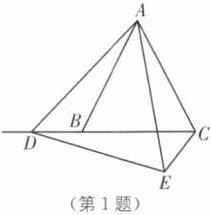 所示,
所示,
$\because ∠ BAD + ∠ BAE=α$,
$∠ BAE + ∠ CAE=α$,
$\therefore ∠ BAD=∠ CAE$.
在$△ BAD$和$△ CAE$中,
$\begin{cases} AB=AC, \\ ∠ BAD=∠ CAE, \\ AD=AE, \end{cases}$
$\therefore △ BAD≌△ CAE(\mathrm{SAS}),\therefore ∠ AEC=∠ ADB$.
$\because ∠ ADE + ∠ AED + α=180°,∠ CDE + ∠ CED + β=180°,∠ CED=∠ AEC + ∠ AED,\therefore α=β$.
(1) 90
(2) ①$\boldsymbol{α+β=180°}$,证明如下:
$\because ∠ BAD + ∠ DAC=α,∠ DAC + ∠ CAE=α$,
$\therefore ∠ BAD=∠ CAE$.
在$△ BAD$和$△ CAE$中,$\begin{cases} AB=AC, \\ ∠ BAD=∠ CAE, \\ AD=AE, \end{cases}$
$\therefore △ BAD≌△ CAE(\mathrm{SAS})$,
$\therefore ∠ B=∠ ACE$.
$\because ∠ B + ∠ ACB=180°-α$,
$\therefore ∠ DCE=∠ ACE + ∠ ACB=180°-α=β$,
$\therefore α+β=180°$.
②$\boldsymbol{α=β}$,证明如下:作出图形如
所示,$\because ∠ BAD + ∠ BAE=α$,
$∠ BAE + ∠ CAE=α$,
$\therefore ∠ BAD=∠ CAE$.
在$△ BAD$和$△ CAE$中,
$\begin{cases} AB=AC, \\ ∠ BAD=∠ CAE, \\ AD=AE, \end{cases}$
$\therefore △ BAD≌△ CAE(\mathrm{SAS}),\therefore ∠ AEC=∠ ADB$.
$\because ∠ ADE + ∠ AED + α=180°,∠ CDE + ∠ CED + β=180°,∠ CED=∠ AEC + ∠ AED,\therefore α=β$.
2. (2026·山东菏泽月考)如图,AE与BD相交于点C,AC=EC,BC=DC,AB=8 cm,点P从点A出发,沿A→B→A方向以2 cm/s的速度运动,点Q同时从点D出发,沿D→E方向以1 cm/s的速度运动,当点P到达点A时,P,Q两点同时停止运动,设点P的运动时间为t s.
(1)当点P在A→B运动时,BP=
(用含t的代数式表示)
(2)求证:AB=ED;
(3)当P,Q,C三点共线时,求t的值.
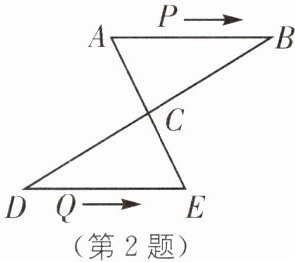
(1)当点P在A→B运动时,BP=
(8-2t)cm
;(用含t的代数式表示)
(2)求证:AB=ED;
(3)当P,Q,C三点共线时,求t的值.
答案:(1) $(8-2t)\mathrm{cm}$
(2) 证明:在$△ ABC$和$△ EDC$中,$\begin{cases} BC=DC, \\ ∠ BCA=∠ DCE, \\ AC=EC, \end{cases}$
$\therefore △ ABC≌△ EDC(\mathrm{SAS}),\therefore AB=ED$.
(3) 根据题意,得$DQ=t\ \mathrm{cm}$,则$EQ=(8-t)\mathrm{cm}$.
$\because △ ABC≌△ EDC,\therefore ∠ A=∠ E,DE=AB=8\ \mathrm{cm}$.
$\because P,Q,C$三点共线,$\therefore ∠ ACP=∠ ECQ$.
在$△ ACP$和$△ ECQ$中,$\begin{cases} ∠ A=∠ E, \\ AC=EC, \\ ∠ ACP=∠ ECQ, \end{cases}$
$\therefore △ ACP≌△ ECQ(\mathrm{ASA}),\therefore AP=EQ$,
$\therefore$ 当$0≤ t≤ 4$时,$2t=8-t$,解得$t=\dfrac{8}{3}$.
当$4< t≤ 8$时,$AP=(16-2t)\mathrm{cm}$,
$\therefore 16-2t=8-t$,解得$t=8$.
综上所述,当$P,Q,C$三点共线时,$t$的值为$\dfrac{8}{3}$或$8$.
(2) 证明:在$△ ABC$和$△ EDC$中,$\begin{cases} BC=DC, \\ ∠ BCA=∠ DCE, \\ AC=EC, \end{cases}$
$\therefore △ ABC≌△ EDC(\mathrm{SAS}),\therefore AB=ED$.
(3) 根据题意,得$DQ=t\ \mathrm{cm}$,则$EQ=(8-t)\mathrm{cm}$.
$\because △ ABC≌△ EDC,\therefore ∠ A=∠ E,DE=AB=8\ \mathrm{cm}$.
$\because P,Q,C$三点共线,$\therefore ∠ ACP=∠ ECQ$.
在$△ ACP$和$△ ECQ$中,$\begin{cases} ∠ A=∠ E, \\ AC=EC, \\ ∠ ACP=∠ ECQ, \end{cases}$
$\therefore △ ACP≌△ ECQ(\mathrm{ASA}),\therefore AP=EQ$,
$\therefore$ 当$0≤ t≤ 4$时,$2t=8-t$,解得$t=\dfrac{8}{3}$.
当$4< t≤ 8$时,$AP=(16-2t)\mathrm{cm}$,
$\therefore 16-2t=8-t$,解得$t=8$.
综上所述,当$P,Q,C$三点共线时,$t$的值为$\dfrac{8}{3}$或$8$.
3. (2026·宁夏固原期末)如图(1),$AB=14\ \mathrm{cm}$,$AC=10\ \mathrm{cm}$,$AC⊥ AB$,$BD⊥ AB$,垂足分别为$A$,$B$,点$P$在线段$AB$上以$2\ \mathrm{cm/s}$的速度由点$A$向点$B$运动,同时点$Q$在射线$BD$上运动,它们运动的时间为$t(\mathrm{s})$(当点$P$运动结束时,点$Q$运动随之结束).
(1)若点$Q$的运动速度与点$P$的运动速度相等,当$t=2$时,$△ ACP$与$△ BPQ$是否全等?并判断此时线段$PC$和线段$PQ$的位置关系,请分别说明理由.
(2)如图(2),若“$AC⊥ AB$,$BD⊥ AB$”改为“$∠ CAB=∠ DBA$”,点$Q$的运动速度为$x\ \mathrm{cm/s}$,其他条件不变,当点$P$,$Q$运动到何处时有$△ ACP$与$△ BPQ$全等?求出相应的$x$和$t$的值.
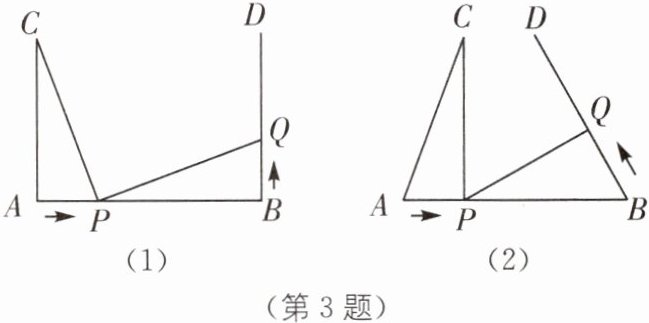
(1)若点$Q$的运动速度与点$P$的运动速度相等,当$t=2$时,$△ ACP$与$△ BPQ$是否全等?并判断此时线段$PC$和线段$PQ$的位置关系,请分别说明理由.
(2)如图(2),若“$AC⊥ AB$,$BD⊥ AB$”改为“$∠ CAB=∠ DBA$”,点$Q$的运动速度为$x\ \mathrm{cm/s}$,其他条件不变,当点$P$,$Q$运动到何处时有$△ ACP$与$△ BPQ$全等?求出相应的$x$和$t$的值.
答案:(1) $\boldsymbol{△ ACP≌△ BPQ}$,$\boldsymbol{PC⊥ PQ}$,理由如下:
$\because AC⊥ AB,BD⊥ AB,\therefore ∠ A=∠ B=90°$.
当$t=2$时,$AP=BQ=2×2=4(\mathrm{cm})$,
$\therefore BP=AB-AP=10\ \mathrm{cm},\therefore BP=AC$.
在$△ ACP$和$△ BPQ$中,$\begin{cases} AP=BQ, \\ ∠ A=∠ B, \\ AC=BP, \end{cases}$
$\therefore △ ACP≌△ BPQ(\mathrm{SAS}),\therefore ∠ C=∠ BPQ$.
$\because ∠ C + ∠ APC=90°,\therefore ∠ APC + ∠ BPQ=90°$,
$\therefore ∠ CPQ=90°,\therefore PC⊥ PQ$.
(2) ①若$△ ACP≌△ BPQ$,
则$AC=BP,AP=BQ$,可得$10=14-2t,2t=xt$,
解得$x=2,t=2$;
②若$△ ACP≌△ BQP$,
则$AC=BQ,AP=BP$,可得$10=xt,2t=14-2t$,
解得$x=\dfrac{20}{7},t=\dfrac{7}{2}$.
综上所述,当$△ ACP$与$△ BPQ$全等时,$x=2,t=2$或$x=\dfrac{20}{7},t=\dfrac{7}{2}$.
$\because AC⊥ AB,BD⊥ AB,\therefore ∠ A=∠ B=90°$.
当$t=2$时,$AP=BQ=2×2=4(\mathrm{cm})$,
$\therefore BP=AB-AP=10\ \mathrm{cm},\therefore BP=AC$.
在$△ ACP$和$△ BPQ$中,$\begin{cases} AP=BQ, \\ ∠ A=∠ B, \\ AC=BP, \end{cases}$
$\therefore △ ACP≌△ BPQ(\mathrm{SAS}),\therefore ∠ C=∠ BPQ$.
$\because ∠ C + ∠ APC=90°,\therefore ∠ APC + ∠ BPQ=90°$,
$\therefore ∠ CPQ=90°,\therefore PC⊥ PQ$.
(2) ①若$△ ACP≌△ BPQ$,
则$AC=BP,AP=BQ$,可得$10=14-2t,2t=xt$,
解得$x=2,t=2$;
②若$△ ACP≌△ BQP$,
则$AC=BQ,AP=BP$,可得$10=xt,2t=14-2t$,
解得$x=\dfrac{20}{7},t=\dfrac{7}{2}$.
综上所述,当$△ ACP$与$△ BPQ$全等时,$x=2,t=2$或$x=\dfrac{20}{7},t=\dfrac{7}{2}$.