4. 分类讨论思想 如图,$CA ⊥ AB$,垂足为$A$,射线$BM ⊥ AB$,垂足为$B$,$AB=12\ \mathrm{cm}$,$AC=6\ \mathrm{cm}$. 动点$E$从点$A$出发以$3\ \mathrm{cm/s}$的速度沿射线$AN$运动,动点$D$在射线$BM$上,随着点$E$运动而运动,始终保持$ED=CB$. 若点$E$的运动时间为$t\ \mathrm{s}(t>0)$,则当$t$为多少时,$△ DEB$与$△ BCA$全等?
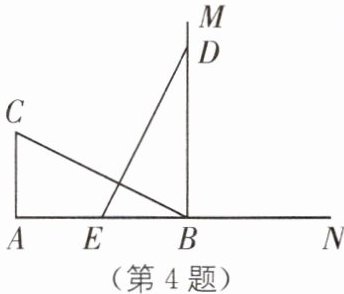
答案:①当点$E$在线段$AB$上,且$AC=BE$时,$△ ACB≌△ BED$,
$\because AC=6\ \mathrm{cm},\therefore BE=6\ \mathrm{cm},\therefore AE=12-6=6(\mathrm{cm})$,
$\therefore$ 点$E$的运动时间为$6÷3=2(\mathrm{s})$;
②当$E$在射线$BN$上,$AC=BE$时,$\because AC=BE=6\ \mathrm{cm}$,
$\therefore AE=12+6=18(\mathrm{cm})$,
$\therefore$ 点$E$的运动时间为$18÷3=6(\mathrm{s})$;
③当$E$在线段$AB$上,$AB=BE$时,$△ ACB≌△ BDE$,这时$E$在$A$点未动,因此时间为$0\ \mathrm{s}$(舍去此情况);
④当$E$在射线$BN$上,$AB=BE$时,$△ ACB≌△ BDE$,
$AE=12+12=24(\mathrm{cm})$,
$\therefore$ 点$E$的运动时间为$24÷3=8(\mathrm{s})$.
综上,$t$的值为$2$或$6$或$8$.
$\because AC=6\ \mathrm{cm},\therefore BE=6\ \mathrm{cm},\therefore AE=12-6=6(\mathrm{cm})$,
$\therefore$ 点$E$的运动时间为$6÷3=2(\mathrm{s})$;
②当$E$在射线$BN$上,$AC=BE$时,$\because AC=BE=6\ \mathrm{cm}$,
$\therefore AE=12+6=18(\mathrm{cm})$,
$\therefore$ 点$E$的运动时间为$18÷3=6(\mathrm{s})$;
③当$E$在线段$AB$上,$AB=BE$时,$△ ACB≌△ BDE$,这时$E$在$A$点未动,因此时间为$0\ \mathrm{s}$(舍去此情况);
④当$E$在射线$BN$上,$AB=BE$时,$△ ACB≌△ BDE$,
$AE=12+12=24(\mathrm{cm})$,
$\therefore$ 点$E$的运动时间为$24÷3=8(\mathrm{s})$.
综上,$t$的值为$2$或$6$或$8$.
5. 一线三等角模型 在$△ ABC$中,$∠ ACB = 90°$,$AC=BC$,直线$MN$经过点$C$,且$AD ⊥ MN$于点$D$,$BE ⊥ MN$于点$E$。
(1)当直线$MN$绕点$C$旋转到图(1)的位置时,求证:①$△ ADC ≌ △ CEB$;②$DE=AD+BE$。
(2)当直线$MN$绕点$C$旋转到图(2)的位置时,(1)中的结论还成立吗?若成立,请给出证明;若不成立,请说明理由。
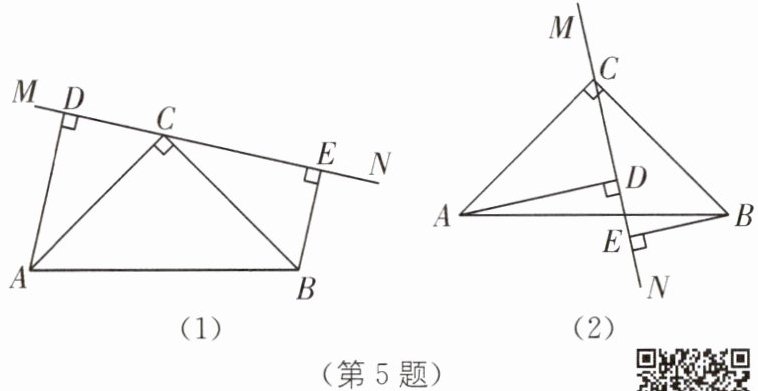
(1)当直线$MN$绕点$C$旋转到图(1)的位置时,求证:①$△ ADC ≌ △ CEB$;②$DE=AD+BE$。
(2)当直线$MN$绕点$C$旋转到图(2)的位置时,(1)中的结论还成立吗?若成立,请给出证明;若不成立,请说明理由。
答案:(1) ①$\because ∠ ACD + ∠ BCE=90°,∠ DAC + ∠ ACD=90°$,
$\therefore ∠ DAC=∠ ECB$.
在$△ ADC$和$△ CEB$中,$\begin{cases} ∠ ADC=∠ CEB=90°, \\ ∠ DAC=∠ ECB, \\ AC=CB, \end{cases}$
$\therefore △ ADC≌△ CEB(\mathrm{AAS})$.
②$\because △ ADC≌△ CEB,\therefore CD=BE,AD=CE$.
$\therefore DE=CE+CD=AD+BE$.
(2) $△ ADC≌△ CEB$成立,$DE=AD+BE$不成立,此时应有$DE=AD-BE$. 理由如下:
$\because ∠ ACD + ∠ BCE=90°,∠ DAC + ∠ ACD=90°$,
$\therefore ∠ DAC=∠ BCE$.
又$AC=CB,∠ ADC=∠ CEB=90°$,
$\therefore △ ADC≌△ CEB(\mathrm{AAS}).\therefore CD=BE,AD=CE$.
$\therefore DE=AD-BE$.
$\therefore ∠ DAC=∠ ECB$.
在$△ ADC$和$△ CEB$中,$\begin{cases} ∠ ADC=∠ CEB=90°, \\ ∠ DAC=∠ ECB, \\ AC=CB, \end{cases}$
$\therefore △ ADC≌△ CEB(\mathrm{AAS})$.
②$\because △ ADC≌△ CEB,\therefore CD=BE,AD=CE$.
$\therefore DE=CE+CD=AD+BE$.
(2) $△ ADC≌△ CEB$成立,$DE=AD+BE$不成立,此时应有$DE=AD-BE$. 理由如下:
$\because ∠ ACD + ∠ BCE=90°,∠ DAC + ∠ ACD=90°$,
$\therefore ∠ DAC=∠ BCE$.
又$AC=CB,∠ ADC=∠ CEB=90°$,
$\therefore △ ADC≌△ CEB(\mathrm{AAS}).\therefore CD=BE,AD=CE$.
$\therefore DE=AD-BE$.