6. 新考法 操作探究 [问题情境]小明用4张全等的直角三角形纸片拼成图(1),利用此图,可以验证勾股定理吗?
[初步运用](1)如图(1),若$b=2a$,则小正方形面积:大正方形面积=
(2)现将图(1)中上方的两直角三角形向内折叠,如图(2),若$a=4$,$b=6$,则此时空白部分的面积为
[迁移运用]用三张含$60°$角的全等三角形纸片,能否拼成一个特殊图形呢?带着这个疑问,小丽拼出图(3)的等边三角形,你能否仿照勾股定理的验证,发现含$60°$角的三角形三边$a,b,c$之间的关系,写出此等量关系式及其推导过程.(知识补充:如图(4),含$60°$角的直角三角形的对边长$y$:斜边长$x=$定值$k$)
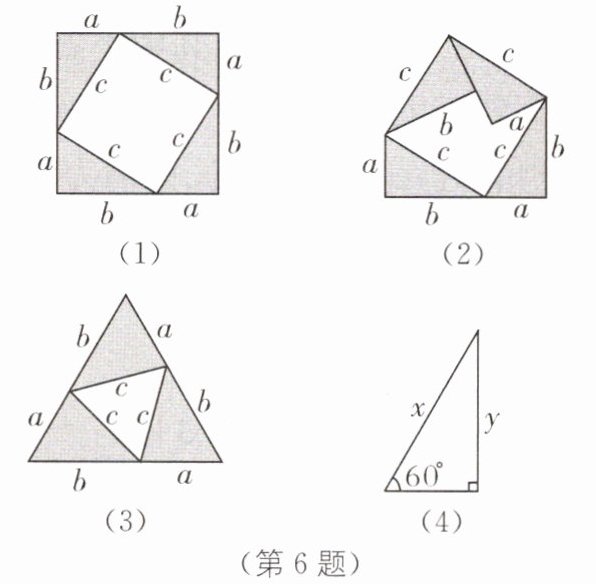
[初步运用](1)如图(1),若$b=2a$,则小正方形面积:大正方形面积=
5:9
.(2)现将图(1)中上方的两直角三角形向内折叠,如图(2),若$a=4$,$b=6$,则此时空白部分的面积为
28
.[迁移运用]用三张含$60°$角的全等三角形纸片,能否拼成一个特殊图形呢?带着这个疑问,小丽拼出图(3)的等边三角形,你能否仿照勾股定理的验证,发现含$60°$角的三角形三边$a,b,c$之间的关系,写出此等量关系式及其推导过程.(知识补充:如图(4),含$60°$角的直角三角形的对边长$y$:斜边长$x=$定值$k$)
答案:[初步运用](1)$5:9$ (2)$28$
[迁移运用]结论:$a^{2}+b^{2}-ab=c^{2}$. 理由如下:
由题意,得大正三角形的面积$=3$个全等三角形的面积$+$小正三角形的面积,$\therefore \frac {1}{2}(a+b)· k(a+b)=3×\frac {1}{2}b· ka+\frac {1}{2}c· ck$,$\therefore (a+b)^{2}=3ab+c^{2}$,$\therefore a^{2}+b^{2}-ab=c^{2}$.
[迁移运用]结论:$a^{2}+b^{2}-ab=c^{2}$. 理由如下:
由题意,得大正三角形的面积$=3$个全等三角形的面积$+$小正三角形的面积,$\therefore \frac {1}{2}(a+b)· k(a+b)=3×\frac {1}{2}b· ka+\frac {1}{2}c· ck$,$\therefore (a+b)^{2}=3ab+c^{2}$,$\therefore a^{2}+b^{2}-ab=c^{2}$.
7. 新考法 类比探究 (2026·连云港外国语学校期末)在$△ ABC$中,$BC=a$,$AC=b$,$AB=c$,且$c≥ b≥ a$.
(1)当$△ ABC$是锐角三角形时,小明猜想:$a^2+b^2>c^2$.以下是他的证明过程:
如图(1),过点$A$作$AD⊥ CB$,垂足为$D$.
设$CD=x$.
$\because$在$\mathrm{Rt}△ ADC$中,$AD^2=b^2-x^2$,
在$\mathrm{Rt}△ ADB$中,$AD^2=\underline{\quad①\quad}$,
$\therefore b^2-x^2=\underline{\quad①\quad}$.
化简,得$a^2+b^2-c^2=2ax$.
$\because a>0,x>0,\therefore \underline{\quad②\quad}>0$,
$\therefore a^2+b^2-c^2>0$,
$\therefore a^2+b^2>c^2$.
其中,①是________,②是________.
(2)如图(2),当$△ ABC$是钝角三角形时,猜想$a^2+b^2$与$c^2$之间的关系并证明.
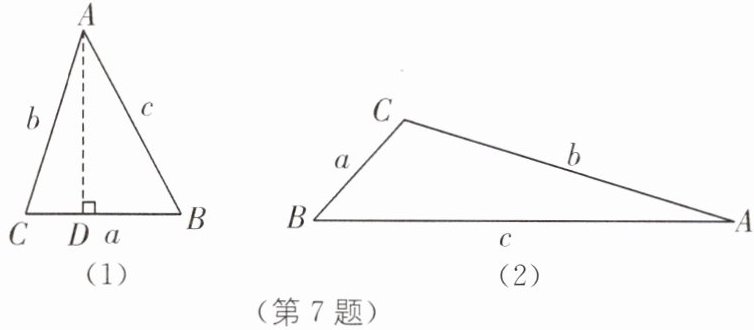
(1)当$△ ABC$是锐角三角形时,小明猜想:$a^2+b^2>c^2$.以下是他的证明过程:
如图(1),过点$A$作$AD⊥ CB$,垂足为$D$.
设$CD=x$.
$\because$在$\mathrm{Rt}△ ADC$中,$AD^2=b^2-x^2$,
在$\mathrm{Rt}△ ADB$中,$AD^2=\underline{\quad①\quad}$,
$\therefore b^2-x^2=\underline{\quad①\quad}$.
化简,得$a^2+b^2-c^2=2ax$.
$\because a>0,x>0,\therefore \underline{\quad②\quad}>0$,
$\therefore a^2+b^2-c^2>0$,
$\therefore a^2+b^2>c^2$.
其中,①是________,②是________.
(2)如图(2),当$△ ABC$是钝角三角形时,猜想$a^2+b^2$与$c^2$之间的关系并证明.
答案:
(1)$c^{2}-(a-x)^{2}$ $2ax$ [解析]如题图(1),过点A作$AD⊥CB$,垂足为D.设$CD=x$,则$DB=a-x$.
$\because$在$\mathrm{Rt}△ ADC$中,$AD^{2}=b^{2}-x^{2}$,在$\mathrm{Rt}△ ADB$中,$AD^{2}=c^{2}-(a-x)^{2}$,$\therefore b^{2}-x^{2}=c^{2}-(a-x)^{2}$,化简,得$a^{2}+b^{2}-c^{2}=2ax$.$\because a>0$,$x>0$,$\therefore 2ax>0$,$\therefore a^{2}+b^{2}-c^{2}>0$,$\therefore a^{2}+b^{2}>c^{2}$.
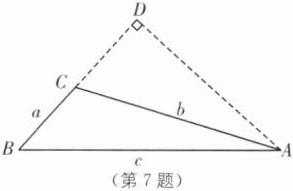
(2)$a^{2}+b^{2}< c^{2}$.证明如下:
如图,过点A作$AD⊥BC$,交BC的延长线于点D.
设$CD=x$.$\because$在$\mathrm{Rt}△ ADC$中,$AD^{2}=b^{2}-x^{2}$,在$\mathrm{Rt}△ ADB$中,$AD^{2}=c^{2}-(a+x)^{2}$,$\therefore b^{2}-x^{2}=c^{2}-(a+x)^{2}$,化简,得$a^{2}+b^{2}-c^{2}=-2ax$.$\because a>0$,$x>0$,$\therefore -2ax<0$,$\therefore a^{2}+b^{2}-c^{2}<0$,$\therefore a^{2}+b^{2}< c^{2}$.
(1)$c^{2}-(a-x)^{2}$ $2ax$ [解析]如题图(1),过点A作$AD⊥CB$,垂足为D.设$CD=x$,则$DB=a-x$.
$\because$在$\mathrm{Rt}△ ADC$中,$AD^{2}=b^{2}-x^{2}$,在$\mathrm{Rt}△ ADB$中,$AD^{2}=c^{2}-(a-x)^{2}$,$\therefore b^{2}-x^{2}=c^{2}-(a-x)^{2}$,化简,得$a^{2}+b^{2}-c^{2}=2ax$.$\because a>0$,$x>0$,$\therefore 2ax>0$,$\therefore a^{2}+b^{2}-c^{2}>0$,$\therefore a^{2}+b^{2}>c^{2}$.
(2)$a^{2}+b^{2}< c^{2}$.证明如下:
如图,过点A作$AD⊥BC$,交BC的延长线于点D.
设$CD=x$.$\because$在$\mathrm{Rt}△ ADC$中,$AD^{2}=b^{2}-x^{2}$,在$\mathrm{Rt}△ ADB$中,$AD^{2}=c^{2}-(a+x)^{2}$,$\therefore b^{2}-x^{2}=c^{2}-(a+x)^{2}$,化简,得$a^{2}+b^{2}-c^{2}=-2ax$.$\because a>0$,$x>0$,$\therefore -2ax<0$,$\therefore a^{2}+b^{2}-c^{2}<0$,$\therefore a^{2}+b^{2}< c^{2}$.