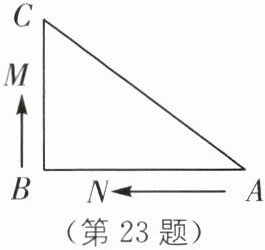
23. (2025·扬州高邮期中)如图,在$△ ABC$中,$∠ B=90°$,$AB=16\ \mathrm{cm}$,$BC=12\ \mathrm{cm}$,$M,N$是$△ ABC$边上的两个动点,其中点$N$从点$A$开始沿$A\to B$方向运动,且速度为$2\ \mathrm{cm/s}$,点$M$从点$B$开始沿$B\to C\to A$方向运动,且速度为$4\ \mathrm{cm/s}$,它们同时出发,设运动的时间为$t\ \mathrm{s}$.
(1)出发$2\ \mathrm{s}$后,求$MN$的长.
(2)当点$M$在边$BC$上运动时,出发几秒钟,$△ MNB$是等腰三角形?
(3)当点$M$在边$CA$上运动时,求能使$△ BCM$成为以$CM$为腰的等腰三角形的$t$的值.
(1)出发$2\ \mathrm{s}$后,求$MN$的长.
(2)当点$M$在边$BC$上运动时,出发几秒钟,$△ MNB$是等腰三角形?
(3)当点$M$在边$CA$上运动时,求能使$△ BCM$成为以$CM$为腰的等腰三角形的$t$的值.
答案:(1)当$t=2$时,$AN=2t=4\ \mathrm{cm}$,$BM=4t=8\ \mathrm{cm}$.
$\because AB=16\ \mathrm{cm}$,$\therefore BN=AB-AN=16-4=12(\mathrm{cm})$.
在$\mathrm{Rt}△ BMN$中,$∠ B=90°$,由勾股定理,可得$MN=\sqrt{BM^2+BN^2}=\sqrt{12^2+8^2}=\sqrt{208}(\mathrm{cm})$,即$MN$的长为$\sqrt{208}\ \mathrm{cm}$.
(2)由题意,可知$AN=2t\ \mathrm{cm}$,$BM=4t\ \mathrm{cm}$.
又$AB=16\ \mathrm{cm}$,$\therefore BN=AB-AN=(16-2t)\mathrm{cm}$.
当$△ MNB$为等腰三角形时,则有$BM=BN$,
$\therefore16-2t=4t$,解得$t=\frac{8}{3}$,
$\therefore$出发$\frac{8}{3}\ \mathrm{s}$时,$△ MNB$是等腰三角形.
(3)在$△ ABC$中,由勾股定理,可求得$AC=20\ \mathrm{cm}$.
当点$M$在$AC$上运动时,$CM=(4t-12)\mathrm{cm}$.
$\because△ BCM$是以$CM$为腰的等腰三角形,
$\therefore$有$CM=BC$,$CM=BM$两种情况:
当$CM=BC=12$时,则$4t-12=12$,解得$t=6$;
当$CM=BM$时,则$∠ C=∠ MBC$,
$\because∠ C+∠ A=90°=∠ CBM+∠ MBA$,
$\therefore∠ A=∠ MBA$,$\therefore MB=MA$,
$\therefore CM=AM=10$,即$4t-12=10$,解得$t=5.5$.
综上可知,当$t$的值为6或5.5时,$△ BCM$为以$CM$为腰的等腰三角形.
$\because AB=16\ \mathrm{cm}$,$\therefore BN=AB-AN=16-4=12(\mathrm{cm})$.
在$\mathrm{Rt}△ BMN$中,$∠ B=90°$,由勾股定理,可得$MN=\sqrt{BM^2+BN^2}=\sqrt{12^2+8^2}=\sqrt{208}(\mathrm{cm})$,即$MN$的长为$\sqrt{208}\ \mathrm{cm}$.
(2)由题意,可知$AN=2t\ \mathrm{cm}$,$BM=4t\ \mathrm{cm}$.
又$AB=16\ \mathrm{cm}$,$\therefore BN=AB-AN=(16-2t)\mathrm{cm}$.
当$△ MNB$为等腰三角形时,则有$BM=BN$,
$\therefore16-2t=4t$,解得$t=\frac{8}{3}$,
$\therefore$出发$\frac{8}{3}\ \mathrm{s}$时,$△ MNB$是等腰三角形.
(3)在$△ ABC$中,由勾股定理,可求得$AC=20\ \mathrm{cm}$.
当点$M$在$AC$上运动时,$CM=(4t-12)\mathrm{cm}$.
$\because△ BCM$是以$CM$为腰的等腰三角形,
$\therefore$有$CM=BC$,$CM=BM$两种情况:
当$CM=BC=12$时,则$4t-12=12$,解得$t=6$;
当$CM=BM$时,则$∠ C=∠ MBC$,
$\because∠ C+∠ A=90°=∠ CBM+∠ MBA$,
$\therefore∠ A=∠ MBA$,$\therefore MB=MA$,
$\therefore CM=AM=10$,即$4t-12=10$,解得$t=5.5$.
综上可知,当$t$的值为6或5.5时,$△ BCM$为以$CM$为腰的等腰三角形.
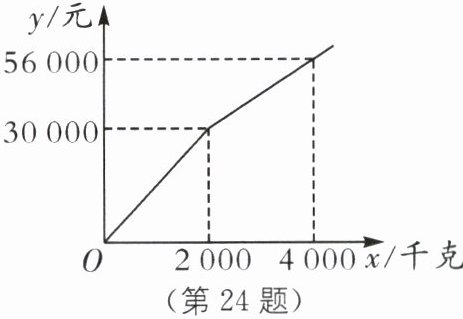
24.(2025·楚雄自治州模拟)某经销商欲购进甲、乙两种产品,甲、乙两种产品的售价分别为12元/千克和18元/千克,甲种产品进价为8元/千克,乙种产品的进货总金额y(元)与乙种产品进货量x(千克)之间的关系如图所示.
(1)求y与x之间的函数表达式;
(2)若该经销商购进甲、乙两种产品共6 000千克,并能全部售出,其中乙种产品的进货量不低于1 600千克,且不高于甲种产品进货量的2倍.设销售完甲、乙两种产品所获总利润为w(元),请求出w与乙种产品进货量x之间的函数表达式,并为该经销商设计出获得最大总利润的进货方案.
(1)求y与x之间的函数表达式;
(2)若该经销商购进甲、乙两种产品共6 000千克,并能全部售出,其中乙种产品的进货量不低于1 600千克,且不高于甲种产品进货量的2倍.设销售完甲、乙两种产品所获总利润为w(元),请求出w与乙种产品进货量x之间的函数表达式,并为该经销商设计出获得最大总利润的进货方案.
答案:(1)当$0≤ x≤2000$时,设$y=k'x$,
$\therefore2000k'=30000$,$\therefore k'=15$,$\therefore y=15x$.
当$x>2000$时,设$y=kx+b$,
$\begin{cases}2000k+b=30000,\\4000k+b=56000,\end{cases}\therefore\begin{cases}k=13,\\b=4000,\end{cases}$
$\therefore y=13x+4000$.
故$y$与$x$之间的函数表达式为
$y=\begin{cases}15x(0≤ x≤2000),\\13x+4000(x>2000).\end{cases}$
(2)由题意,可得购进甲种产品$(6000-x)$千克,
则$\begin{cases}x≥1600,\\x≤2(6000-x),\end{cases}\therefore1600≤ x≤4000$.
当$1600≤ x≤2000$时,$w=(12-8)×(6000-x)+(18-15)x=-x+24000$.
$\because-1<0$,$\therefore w$随$x$值的增大而减小,
$\therefore$当$x=1600$时,$w$取得最大值,最大值为$-1×1600+24000=22400$(元);
当$2000<x≤4000$时,$w=(12-8)×(6000-x)+18x-(13x+4000)=x+20000$.
$\because1>0$,$\therefore w$随$x$值的增大而增大,
$\therefore$当$x=4000$时,$w$取得最大值,最大值为$4000+20000=24000$(元).此时,$6000-4000=2000$(千克).
故当购进甲产品2000千克,乙产品4000千克时,总利润最大,最大总利润为24000元.
$\therefore2000k'=30000$,$\therefore k'=15$,$\therefore y=15x$.
当$x>2000$时,设$y=kx+b$,
$\begin{cases}2000k+b=30000,\\4000k+b=56000,\end{cases}\therefore\begin{cases}k=13,\\b=4000,\end{cases}$
$\therefore y=13x+4000$.
故$y$与$x$之间的函数表达式为
$y=\begin{cases}15x(0≤ x≤2000),\\13x+4000(x>2000).\end{cases}$
(2)由题意,可得购进甲种产品$(6000-x)$千克,
则$\begin{cases}x≥1600,\\x≤2(6000-x),\end{cases}\therefore1600≤ x≤4000$.
当$1600≤ x≤2000$时,$w=(12-8)×(6000-x)+(18-15)x=-x+24000$.
$\because-1<0$,$\therefore w$随$x$值的增大而减小,
$\therefore$当$x=1600$时,$w$取得最大值,最大值为$-1×1600+24000=22400$(元);
当$2000<x≤4000$时,$w=(12-8)×(6000-x)+18x-(13x+4000)=x+20000$.
$\because1>0$,$\therefore w$随$x$值的增大而增大,
$\therefore$当$x=4000$时,$w$取得最大值,最大值为$4000+20000=24000$(元).此时,$6000-4000=2000$(千克).
故当购进甲产品2000千克,乙产品4000千克时,总利润最大,最大总利润为24000元.