(
A.How was the weather last week?
B.How are you doing?
C.What fine weather!
D.What is the weather like?
A
)8. — —It was fine but a little cold.A.How was the weather last week?
B.How are you doing?
C.What fine weather!
D.What is the weather like?
答案:8. A 【点拨】根据答语可知,问句是询问天气怎么样,排除 B、C 项;由答语中的 was 可知,所以问句的时态应为一般过去时。故选 A。
解析:
【分析】首先观察答语,答语使用了一般过去时(was),内容是描述天气状况,因此问句需满足两个条件:一是询问天气,二是使用一般过去时。接下来逐一分析选项:B选项询问近况,C选项是感叹句而非问句,D选项是一般现在时询问天气,时态不符;只有A选项是一般过去时询问天气,符合答语要求。
【解析】根据答语“It was fine but a little cold.”可知,问句需满足两个要点:①询问天气状况;②时态为一般过去时。逐一分析选项:A项“How was the weather last week?”意为“上周天气怎么样?”,是一般过去时的天气询问句,符合要求;B项“How are you doing?”意为“你近况如何?”,答语并非回应近况,排除;C项“What fine weather!”是感叹句,不是问句,排除;D项“What is the weather like?”是一般现在时的天气询问句,时态与答语不符,排除。因此选A。
【答案】A
【知识点】情景交际、一般过去时、特殊疑问句
【点评】本题考查情景交际中的天气询问,需结合答语的时态和话题进行判断,属于基础题型,难度较低。
【难度系数】0.7
【解析】根据答语“It was fine but a little cold.”可知,问句需满足两个要点:①询问天气状况;②时态为一般过去时。逐一分析选项:A项“How was the weather last week?”意为“上周天气怎么样?”,是一般过去时的天气询问句,符合要求;B项“How are you doing?”意为“你近况如何?”,答语并非回应近况,排除;C项“What fine weather!”是感叹句,不是问句,排除;D项“What is the weather like?”是一般现在时的天气询问句,时态与答语不符,排除。因此选A。
【答案】A
【知识点】情景交际、一般过去时、特殊疑问句
【点评】本题考查情景交际中的天气询问,需结合答语的时态和话题进行判断,属于基础题型,难度较低。
【难度系数】0.7
四、词语运用。
根据短文内容和首字母提示,在下文空格处填入适当的词使短文完整。
You must have heard of Sanfu Days. Well, Sanfu Days are also known as the “Chinese dog days of summer”. They mark the h 1 days of summer.
Sanfu Days include t 2 periods(时期):Toufu, Zhongfu and Mofu. In Chinese, “Fu” h 3 the meaning of “hiding”. So it is also a suggestion for people to stay a 4 home to “hide” from the intense heat outdoors in summer.
Sanfu Days usually come between mid-July a 5 mid-August. During this time, Chinese people follow different traditional w 6 to deal with the heat and stay healthy. Now let's have a l 7 at some customs(习俗) of spending the Chinese dog days of summer.
In Changsha, local people often eat roosters(公鸡) during Sanfu Days, especially during Toufu. That's because it is always hot with heavy rain in summer. Local people believe that eating roosters can clear the wet in t 8 body. And there is even an old saying that goes, “A rooster at the b 9 of Sanfu Days, a healthy body the whole year.”
Besides, the tradition of using Sanfutie is also known in China during Sanfu Days. It is a kind of Sanfu medicinal patch. Many people use Sanfutie to h 10 them fight some winter illnesses.
1. 2. 3. 4. 5.
6. 7. 8. 9. 10.
根据短文内容和首字母提示,在下文空格处填入适当的词使短文完整。
You must have heard of Sanfu Days. Well, Sanfu Days are also known as the “Chinese dog days of summer”. They mark the h 1 days of summer.
Sanfu Days include t 2 periods(时期):Toufu, Zhongfu and Mofu. In Chinese, “Fu” h 3 the meaning of “hiding”. So it is also a suggestion for people to stay a 4 home to “hide” from the intense heat outdoors in summer.
Sanfu Days usually come between mid-July a 5 mid-August. During this time, Chinese people follow different traditional w 6 to deal with the heat and stay healthy. Now let's have a l 7 at some customs(习俗) of spending the Chinese dog days of summer.
In Changsha, local people often eat roosters(公鸡) during Sanfu Days, especially during Toufu. That's because it is always hot with heavy rain in summer. Local people believe that eating roosters can clear the wet in t 8 body. And there is even an old saying that goes, “A rooster at the b 9 of Sanfu Days, a healthy body the whole year.”
Besides, the tradition of using Sanfutie is also known in China during Sanfu Days. It is a kind of Sanfu medicinal patch. Many people use Sanfutie to h 10 them fight some winter illnesses.
1. 2. 3. 4. 5.
6. 7. 8. 9. 10.
答案:1. hottest 2. three 3. has 4. at 5. and 6. ways
7. look 8. their 9. beginning 10. help
7. look 8. their 9. beginning 10. help
解析:
【分析】本题为根据短文内容和首字母提示填单词的题型,解题思路为:首先通读全文,理解短文关于三伏天的介绍大意;接着逐个分析每个空格,结合首字母提示、句子语境、固定搭配、语法规则(如名词单复数、动词时态、形容词最高级、物主代词等)确定合适的单词,确保填入后语句通顺、符合逻辑。
【解析】1. 由前文“Chinese dog days of summer”可知,三伏天是夏天最热的日子,结合首字母h,用形容词最高级hottest;2. 后文提到Toufu、Zhongfu、Mofu三个时期,结合首字母t,填数词three;3. 此处表示“Fu有‘隐藏’的意思”,主语“Fu”为单数,一般现在时,结合首字母h,填has;4. 固定搭配stay at home(呆在家里),结合首字母a,填at;5. 固定搭配between...and...(在……和……之间),结合首字母a,填and;6. 句意为“遵循不同的传统方式应对炎热”,different后接名词复数,结合首字母w,填ways;7. 固定搭配have a look at(看一看),结合首字母l,填look;8. 此处表示“他们的身体”,修饰名词body用形容词性物主代词,结合首字母t,填their;9. 谚语意为“三伏天开始时吃公鸡,一年身体好”,结合首字母b,用the beginning of(……的开始),填beginning;10. 句意为“帮助他们对抗冬季疾病”,use sth to do结构,结合首字母h,填help。
【答案】1. hottest 2. three 3. has 4. at 5. and 6. ways 7. look 8. their 9. beginning 10. help
【知识点】英语词语运用、固定搭配、词形变化
【点评】本题围绕三伏天的习俗展开,考查学生对词汇、固定搭配及语法的综合运用能力,需结合上下文逻辑分析,是初中英语常见的基础题型。
【难度系数】0.6
【解析】1. 由前文“Chinese dog days of summer”可知,三伏天是夏天最热的日子,结合首字母h,用形容词最高级hottest;2. 后文提到Toufu、Zhongfu、Mofu三个时期,结合首字母t,填数词three;3. 此处表示“Fu有‘隐藏’的意思”,主语“Fu”为单数,一般现在时,结合首字母h,填has;4. 固定搭配stay at home(呆在家里),结合首字母a,填at;5. 固定搭配between...and...(在……和……之间),结合首字母a,填and;6. 句意为“遵循不同的传统方式应对炎热”,different后接名词复数,结合首字母w,填ways;7. 固定搭配have a look at(看一看),结合首字母l,填look;8. 此处表示“他们的身体”,修饰名词body用形容词性物主代词,结合首字母t,填their;9. 谚语意为“三伏天开始时吃公鸡,一年身体好”,结合首字母b,用the beginning of(……的开始),填beginning;10. 句意为“帮助他们对抗冬季疾病”,use sth to do结构,结合首字母h,填help。
【答案】1. hottest 2. three 3. has 4. at 5. and 6. ways 7. look 8. their 9. beginning 10. help
【知识点】英语词语运用、固定搭配、词形变化
【点评】本题围绕三伏天的习俗展开,考查学生对词汇、固定搭配及语法的综合运用能力,需结合上下文逻辑分析,是初中英语常见的基础题型。
【难度系数】0.6
五、阅读理解。
Every season brings special things—flowers in spring, sunshine in summer, colourful leaves in autumn, and snow in winter. People have created fun sayings and expressions about these seasons over the years. Let's get to know some of them!
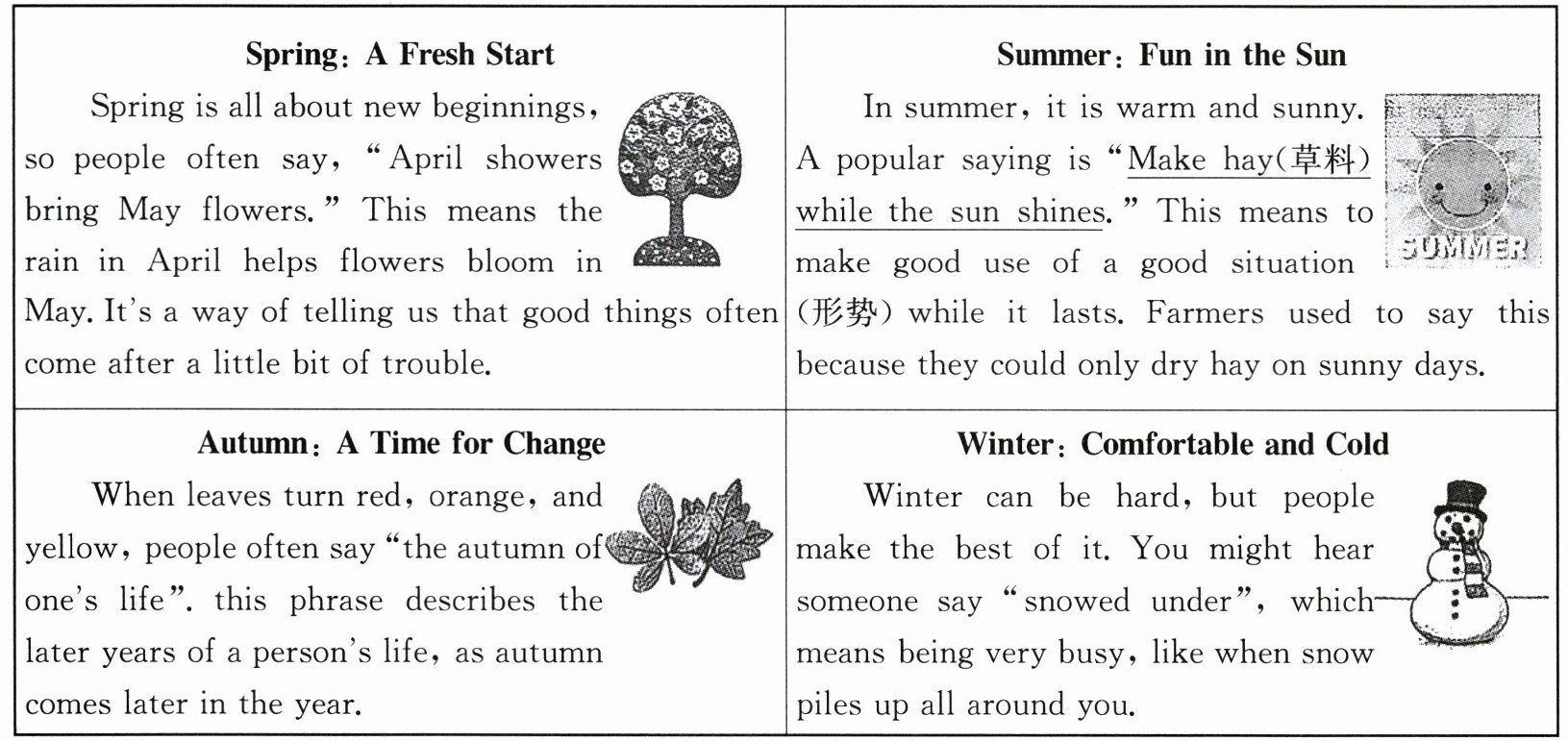
Seasonal sayings are like little bits of wisdom(智慧) in fun words. So next time you hear one, think about how it connects to the world around you!
(
A. History. B. Health. C. Technology. D. Nature.
(
A. It is about working only in summer.
B. It teaches us to work when we have a chance.
C. It tells us to rest during sunny days.
D. It tells us to dry some grass in spring.
(
A. People should enjoy all the seasons.
B. Different seasons have their own weather.
C. Seasonal sayings help us understand life and nature.
D. Spring and summer are better than autumn and winter.
Every season brings special things—flowers in spring, sunshine in summer, colourful leaves in autumn, and snow in winter. People have created fun sayings and expressions about these seasons over the years. Let's get to know some of them!
Seasonal sayings are like little bits of wisdom(智慧) in fun words. So next time you hear one, think about how it connects to the world around you!
(
D
)1. In which part of a magazine can we find this article?A. History. B. Health. C. Technology. D. Nature.
(
B
)2. What can you learn from the underlined sentence “Make hay(草料) while the sun shines”?A. It is about working only in summer.
B. It teaches us to work when we have a chance.
C. It tells us to rest during sunny days.
D. It tells us to dry some grass in spring.
(
C
)3. What is the main idea of the article?A. People should enjoy all the seasons.
B. Different seasons have their own weather.
C. Seasonal sayings help us understand life and nature.
D. Spring and summer are better than autumn and winter.
答案:1. D 【点拨】根据全文内容可知,本文介绍的是有关季节的内容,可以在杂志的自然版块找到这篇文章。故选 D。
2. B 【点拨】根据“This means to make good use of a good situation(形势) while it lasts.”可知,“Make hay(草料) while the sun shines.”教会我们要抓住机会。故选 B。
3. C 【点拨】根据“Seasonal sayings are like little bits of wisdom(智慧) in fun words.”可知,这篇文章的主旨是与季节相关的谚语帮助我们理解生活和自然。故选 C。
2. B 【点拨】根据“This means to make good use of a good situation(形势) while it lasts.”可知,“Make hay(草料) while the sun shines.”教会我们要抓住机会。故选 B。
3. C 【点拨】根据“Seasonal sayings are like little bits of wisdom(智慧) in fun words.”可知,这篇文章的主旨是与季节相关的谚语帮助我们理解生活和自然。故选 C。
解析:
【分析】
首先,第1题是细节理解题,需判断文章所属的杂志版块,文章围绕季节相关的谚语展开,属于自然范畴,据此分析选项;第2题是句意理解题,需定位划线句的解释,原文明确说明该句意为要利用好持续的好形势,据此匹配选项;第3题是主旨大意题,需梳理全文核心,文章介绍季节谚语的智慧,点明其帮助理解生活与自然,据此确定主旨。
【解析】
1. 文章围绕季节相关的谚语展开,属于自然类内容,因此可在杂志的自然版块找到,故选D。
2. 原文明确指出划线句“Make hay while the sun shines”的含义是“to make good use of a good situation while it lasts”,即要抓住机会,对应选项B。
3. 全文围绕季节谚语展开,点明这类谚语是蕴含智慧的趣味表达,帮助理解生活与自然,对应选项C。
【答案】
1.D 2.B 3.C
【知识点】
阅读理解、英语谚语、主旨大意
【点评】
本题为英语阅读理解题,考查细节理解、句意理解及主旨大意,内容贴近生活,难度适中,需学生结合原文信息分析选项。
【难度系数】
0.7
首先,第1题是细节理解题,需判断文章所属的杂志版块,文章围绕季节相关的谚语展开,属于自然范畴,据此分析选项;第2题是句意理解题,需定位划线句的解释,原文明确说明该句意为要利用好持续的好形势,据此匹配选项;第3题是主旨大意题,需梳理全文核心,文章介绍季节谚语的智慧,点明其帮助理解生活与自然,据此确定主旨。
【解析】
1. 文章围绕季节相关的谚语展开,属于自然类内容,因此可在杂志的自然版块找到,故选D。
2. 原文明确指出划线句“Make hay while the sun shines”的含义是“to make good use of a good situation while it lasts”,即要抓住机会,对应选项B。
3. 全文围绕季节谚语展开,点明这类谚语是蕴含智慧的趣味表达,帮助理解生活与自然,对应选项C。
【答案】
1.D 2.B 3.C
【知识点】
阅读理解、英语谚语、主旨大意
【点评】
本题为英语阅读理解题,考查细节理解、句意理解及主旨大意,内容贴近生活,难度适中,需学生结合原文信息分析选项。
【难度系数】
0.7