一、单项选择
(
A.which
B.what
C.that
D.who
(
C
) 1. There is nothing in the world can frighten him.A.which
B.what
C.that
D.who
答案:1.C
解析:
【分析】本题是定语从句的单项选择题,解题思路:1. 先判断句子结构,空格处需填关系代词引导定语从句,修饰先行词nothing;2. 回忆定语从句关系代词的用法:当先行词是不定代词(如nothing、something等)时,关系代词只能用that,不能用which;3. 排除错误选项:what不能引导定语从句,who用于指代人,which不适用于不定代词作先行词的情况,因此确定答案。
【解析】本题考查定语从句中关系代词的用法。首先,空格处引导定语从句,先行词为不定代词nothing。根据定语从句规则,当先行词是不定代词时,关系代词只能用that,不能用which;what不能引导定语从句,who用于指代人,均不符合要求。因此正确答案为that,对应选项C。
【答案】C
【知识点】定语从句(关系代词用法)
【点评】本题考查定语从句中关系代词的特殊用法,属于基础考点,需牢记不定代词作先行词时关系代词用that的规则。
【难度系数】0.7
【解析】本题考查定语从句中关系代词的用法。首先,空格处引导定语从句,先行词为不定代词nothing。根据定语从句规则,当先行词是不定代词时,关系代词只能用that,不能用which;what不能引导定语从句,who用于指代人,均不符合要求。因此正确答案为that,对应选项C。
【答案】C
【知识点】定语从句(关系代词用法)
【点评】本题考查定语从句中关系代词的特殊用法,属于基础考点,需牢记不定代词作先行词时关系代词用that的规则。
【难度系数】0.7
(
—I like the films make me feel happy and relaxed.
A.what
B.which
C.who
D./
B
) 2. —What kind of films do you like best?—I like the films make me feel happy and relaxed.
A.what
B.which
C.who
D./
答案:2.B
解析:
【分析】这是一道定语从句的选择题,解题思路:1. 先判断空格所在句子是修饰先行词the films的定语从句;2. 确定先行词the films是表示“物”的名词,且定语从句中缺少主语;3. 回忆定语从句关系代词的用法:指代物且在从句中作主语时用which/that,what不能引导定语从句,who指代人,作主语时不能省略,据此排除错误选项。
【解析】句子中the films是先行词,空格处引导定语从句修饰先行词,且在从句中作主语。A选项what不能引导定语从句,排除;C选项who用于指代人,先行词是物,排除;D选项关系代词在定语从句中作主语时不能省略,排除;B选项which可指代物,在从句中作主语,符合要求,故选B。
【答案】B
【知识点】定语从句(关系代词用法)
【点评】本题考查定语从句关系代词的基础用法,属于初中英语核心考点,只要掌握先行词指物且在从句中作主语时的关系代词选择规则即可轻松解答。
【难度系数】0.7
【解析】句子中the films是先行词,空格处引导定语从句修饰先行词,且在从句中作主语。A选项what不能引导定语从句,排除;C选项who用于指代人,先行词是物,排除;D选项关系代词在定语从句中作主语时不能省略,排除;B选项which可指代物,在从句中作主语,符合要求,故选B。
【答案】B
【知识点】定语从句(关系代词用法)
【点评】本题考查定语从句关系代词的基础用法,属于初中英语核心考点,只要掌握先行词指物且在从句中作主语时的关系代词选择规则即可轻松解答。
【难度系数】0.7
(
A.what
B.which
C.who
D.whom
C
) 3. A true friend is a person will always be there to share your laughter and tears.A.what
B.which
C.who
D.whom
答案:3.C
解析:
【分析】首先,这是一道定语从句的关系词选择题。第一步,确定先行词:空格前的"a person"是先行词,指代人;第二步,分析定语从句的成分:从句"____ will always be there to share your laughter and tears"中缺少主语,需要一个能在从句中作主语且指代人的关系词;第三步,辨析选项:A选项what不能引导定语从句,B选项which指代物,C选项who指代人且可在从句中作主语,D选项whom指代人但仅在从句中作宾语,由此确定答案。
【解析】本题考查定语从句的关系代词用法。先行词为"a person"(指人),定语从句中缺少主语,需选用指代人且作主语的关系代词。A项what不用于定语从句;B项which指代物;D项whom在从句中作宾语,均不符合要求,因此选C。
【答案】C
【知识点】定语从句(关系代词的用法)
【点评】本题是定语从句的基础题型,重点考查关系代词who与whom的区别,需准确判断先行词指代对象及从句所缺成分,难度较低,适合初中阶段学生巩固知识点。
【难度系数】0.7
【解析】本题考查定语从句的关系代词用法。先行词为"a person"(指人),定语从句中缺少主语,需选用指代人且作主语的关系代词。A项what不用于定语从句;B项which指代物;D项whom在从句中作宾语,均不符合要求,因此选C。
【答案】C
【知识点】定语从句(关系代词的用法)
【点评】本题是定语从句的基础题型,重点考查关系代词who与whom的区别,需准确判断先行词指代对象及从句所缺成分,难度较低,适合初中阶段学生巩固知识点。
【难度系数】0.7
(
A.which
B.who
C.whose
D./
A
) 4. The app is a kind of communication tool can help people talk to friends, and share photos, ideas and feelings anytime, anywhere.A.which
B.who
C.whose
D./
答案:4.A
解析:
【分析】首先判断该句为定语从句,需先确定先行词和关系词在从句中的成分:先行词是“communication tool”(指物),关系词在从句“____ can help people talk to friends...”中作主语。接下来结合选项分析:A选项which可指代物且在从句中作主语;B选项who指代人,不符合先行词属性;C选项whose在从句中作定语,表所属,不符合;D选项关系词作主语时不能省略,排除。
【解析】该句是定语从句,先行词为表物的“communication tool”,关系词在从句中作主语。A项which指代物,可在定语从句中作主语,符合要求;B项who用于指代人,先行词为物,排除;C项whose在从句中作定语,不符合此处成分要求;D项当关系词在从句中作主语时不可省略,排除。因此选A。
【答案】A
【知识点】定语从句关系词、代词辨析
【点评】本题考查定语从句关系词的基础用法,核心是判断先行词的属性和关系词在从句中的成分,属于初中英语常规考点,难度较低。
【难度系数】0.7
【解析】该句是定语从句,先行词为表物的“communication tool”,关系词在从句中作主语。A项which指代物,可在定语从句中作主语,符合要求;B项who用于指代人,先行词为物,排除;C项whose在从句中作定语,不符合此处成分要求;D项当关系词在从句中作主语时不可省略,排除。因此选A。
【答案】A
【知识点】定语从句关系词、代词辨析
【点评】本题考查定语从句关系词的基础用法,核心是判断先行词的属性和关系词在从句中的成分,属于初中英语常规考点,难度较低。
【难度系数】0.7
(
—With the help of his father, I think.
A.that
B.why
C.how
D.when
C
) 5. —Do you know he worked out the problem?—With the help of his father, I think.
A.that
B.why
C.how
D.when
答案:5.C
解析:
【分析】首先观察对话答语“With the help of his father”,这是表示做某事的方式,说明问句是在询问“他如何解出这道题”,需要选择表“如何、怎样”的疑问词引导宾语从句,结合选项逐一判断。
【解析】本题考查宾语从句的引导词。答语体现了解题的方式,因此问句是对方式提问,需用疑问词how(如何);that无实际意义,why提问原因,when提问时间,均不符合答语的语境,故选C。
【答案】C
【知识点】宾语从句引导词
【点评】本题结合情景对话考查宾语从句引导词的用法,需根据答语的语境匹配对应疑问词,属于基础题型。
【难度系数】0.7
【解析】本题考查宾语从句的引导词。答语体现了解题的方式,因此问句是对方式提问,需用疑问词how(如何);that无实际意义,why提问原因,when提问时间,均不符合答语的语境,故选C。
【答案】C
【知识点】宾语从句引导词
【点评】本题结合情景对话考查宾语从句引导词的用法,需根据答语的语境匹配对应疑问词,属于基础题型。
【难度系数】0.7
(
A.since
B.unless
C.if
D.although
D
) 6. Mary’s speech impresses all teachers, she has just started learning public speaking recently.A.since
B.unless
C.if
D.although
答案:6.D
解析:
【分析】
本题考查连词的用法,需先理清前后句的逻辑关系。前半句意为“玛丽的演讲给所有老师留下了深刻印象”,后半句意为“她最近才开始学习公开演讲”,前后是转折让步的逻辑,需选择表让步关系的连词,再逐一分析选项即可得出答案。
【解析】
首先分析句子逻辑:前半句“Mary’s speech impresses all teachers”和后半句“she has just started learning public speaking recently”为让步关系,即“虽然她刚学公开演讲,但演讲很出色”。
选项分析:A.since表“自从;因为”,不符合逻辑;B.unless表“除非”,引导条件状语从句,不符合;C.if表“如果”,引导条件状语从句,不符合;D.although表“虽然;尽管”,引导让步状语从句,符合前后句逻辑关系。
【答案】
6.D
【知识点】
连词(让步状语从句)
【点评】
本题考查让步状语从句的连词辨析,核心是把握前后句的逻辑关系,属于基础题型,难度较低。
【难度系数】
0.8
本题考查连词的用法,需先理清前后句的逻辑关系。前半句意为“玛丽的演讲给所有老师留下了深刻印象”,后半句意为“她最近才开始学习公开演讲”,前后是转折让步的逻辑,需选择表让步关系的连词,再逐一分析选项即可得出答案。
【解析】
首先分析句子逻辑:前半句“Mary’s speech impresses all teachers”和后半句“she has just started learning public speaking recently”为让步关系,即“虽然她刚学公开演讲,但演讲很出色”。
选项分析:A.since表“自从;因为”,不符合逻辑;B.unless表“除非”,引导条件状语从句,不符合;C.if表“如果”,引导条件状语从句,不符合;D.although表“虽然;尽管”,引导让步状语从句,符合前后句逻辑关系。
【答案】
6.D
【知识点】
连词(让步状语从句)
【点评】
本题考查让步状语从句的连词辨析,核心是把握前后句的逻辑关系,属于基础题型,难度较低。
【难度系数】
0.8
二、划出下面片段中的定语从句
There are inspiring tales about talented painters. One well-known figure was Vincent van Gogh, the post-impressionist painter who created vibrant artworks even when he faced great hardship (艰辛). He often used simple materials that he could easily find, like cheap canvas and basic oil paints. Another remarkable artist was Frida Kahlo. She painted self-portraits that showed her physical pain and emotional depth, using bright colours that made her pieces stand out. Even when she was bedridden, she found ways to create art that touched people’s hearts.
There are inspiring tales about talented painters. One well-known figure was Vincent van Gogh, the post-impressionist painter who created vibrant artworks even when he faced great hardship (艰辛). He often used simple materials that he could easily find, like cheap canvas and basic oil paints. Another remarkable artist was Frida Kahlo. She painted self-portraits that showed her physical pain and emotional depth, using bright colours that made her pieces stand out. Even when she was bedridden, she found ways to create art that touched people’s hearts.
答案:

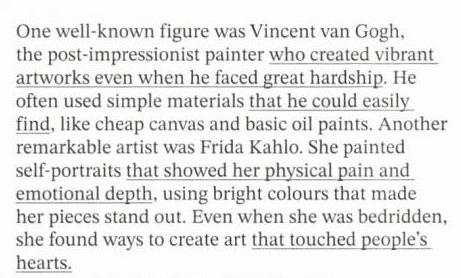
解析:
【分析】要找出文本中的定语从句,需先明确定语从句的核心特征:修饰名词/代词(先行词),由关系代词who(指人)、that(指人/物)引导。解题步骤:1. 通读给定文本,定位被修饰的名词或代词;2. 找到紧跟先行词后、由who/that引导的从句,即为定语从句,据此逐一排查文本内容。
【解析】根据定语从句的定义,在文本中识别出的定语从句为:
1. who created vibrant artworks even when he faced great hardship
2. that he could easily find
3. that showed her physical pain and emotional depth
4. that made her pieces stand out
5. that touched people’s hearts
【答案】
【知识点】定语从句识别;关系代词who/that
【点评】本题考查定语从句的基础识别,是英语语法的常考基础题型,需明确先行词与关系词的对应关系。
【难度系数】0.6
【解析】根据定语从句的定义,在文本中识别出的定语从句为:
1. who created vibrant artworks even when he faced great hardship
2. that he could easily find
3. that showed her physical pain and emotional depth
4. that made her pieces stand out
5. that touched people’s hearts
【答案】
【知识点】定语从句识别;关系代词who/that
【点评】本题考查定语从句的基础识别,是英语语法的常考基础题型,需明确先行词与关系词的对应关系。
【难度系数】0.6
三、阅读与回答问题
Inner painting, a kind of traditional Chinese art, is listed as a national-level intangible cultural heritage (非物质文化遗产) item. Inner painting artists traditionally create works on the inner surfaces of glass bottles by using special fine brushes that can enter the tiny bottles. It has a long history and is mainly divided into four major schools: Beijing, Hebei, Shandong and Guangdong.
When we look at the inner painting of an object, we experience an indescribable beauty. Patterns on the painting often symbolize people’s wishes for good luck and a happy life. The most marketable ones are landscapes followed by flowers and birds.
The production of inner painting is difficult because it requires high precision (精确) and the process of painting is totally reversed (反向的). During painting, there is no room for corrections. And a shaky hand leads to mistakes. Only those who are skilled and confident in their abilities can paint well. Most artists need to learn inner painting for years before creating excellent works. Even if they already know how to paint, they need to practise drawing lines from the beginning when they start inner painting.
Inner painting has its advantages due to its uniqueness (独特性), but it also faces challenges like limited market needs and a shortage of learners and talented artists.
Luckily, today’s artists are trying to make inner painting a bigger part of our lives. It is now used on everyday objects, like tea sets and folding screens. One of the artists invented a new type of brush, which improved the speed of drawing. Some young artists are making use of social media to help more people learn about inner painting skills.
Looking ahead to the future, the inner painting artists hope the art can be more available to the public, and win wider market acceptance. They also hope inner painting courses can be offered at school for young people to take.
1. Where do inner painting artists traditionally create their works?
2. What do patterns on the painting often symbolize?
3. What is not good for the development of inner painting?
4. How are some young artists helping more people learn about inner painting skills?
5. If your school offers an inner painting course, would you like to take it? Why? (请自拟一句话作答)
Inner painting, a kind of traditional Chinese art, is listed as a national-level intangible cultural heritage (非物质文化遗产) item. Inner painting artists traditionally create works on the inner surfaces of glass bottles by using special fine brushes that can enter the tiny bottles. It has a long history and is mainly divided into four major schools: Beijing, Hebei, Shandong and Guangdong.
When we look at the inner painting of an object, we experience an indescribable beauty. Patterns on the painting often symbolize people’s wishes for good luck and a happy life. The most marketable ones are landscapes followed by flowers and birds.
The production of inner painting is difficult because it requires high precision (精确) and the process of painting is totally reversed (反向的). During painting, there is no room for corrections. And a shaky hand leads to mistakes. Only those who are skilled and confident in their abilities can paint well. Most artists need to learn inner painting for years before creating excellent works. Even if they already know how to paint, they need to practise drawing lines from the beginning when they start inner painting.
Inner painting has its advantages due to its uniqueness (独特性), but it also faces challenges like limited market needs and a shortage of learners and talented artists.
Luckily, today’s artists are trying to make inner painting a bigger part of our lives. It is now used on everyday objects, like tea sets and folding screens. One of the artists invented a new type of brush, which improved the speed of drawing. Some young artists are making use of social media to help more people learn about inner painting skills.
Looking ahead to the future, the inner painting artists hope the art can be more available to the public, and win wider market acceptance. They also hope inner painting courses can be offered at school for young people to take.
1. Where do inner painting artists traditionally create their works?
On the inner surface of glass bottles.
2. What do patterns on the painting often symbolize?
People's wishes for good luck and a happy life.
3. What is not good for the development of inner painting?
Challenges like limited market needs and a shortage of learners and talented artists.
4. How are some young artists helping more people learn about inner painting skills?
By making use of social media.
5. If your school offers an inner painting course, would you like to take it? Why? (请自拟一句话作答)
Yes, because I can learn more about traditional Chinese art. (言之有理即可)
答案:1. On the inner surface of glass bottles.
2. People's wishes for good luck and a happy life.
3. Challenges like limited market needs and a shortage of learners and talented artists.
4. By making use of social media.
5. Yes, because I can learn more about traditional Chinese art. (言之有理即可)
2. People's wishes for good luck and a happy life.
3. Challenges like limited market needs and a shortage of learners and talented artists.
4. By making use of social media.
5. Yes, because I can learn more about traditional Chinese art. (言之有理即可)
解析:
【分析】本题为英语阅读理解回答问题,解题思路是:针对每道题的关键词,在原文中定位对应信息,提取准确内容;第5题为开放性问题,需结合自身实际,言之有理即可。
【解析】1. 定位原文第一段第二句“Inner painting artists traditionally create works on the inner surfaces of glass bottles...”,提取答案;2. 定位原文第二段第二句“Patterns on the painting often symbolize people’s wishes for good luck and a happy life”,提取答案;3. 定位原文第四段“it also faces challenges like limited market needs and a shortage of learners and talented artists”,提取不利于发展的内容;4. 定位原文第五段最后一句“Some young artists are making use of social media to help more people learn about inner painting skills”,提取答案;5. 结合自身对传统艺术的兴趣,给出合理回答。
【答案】1. On the inner surface of glass bottles.
2. People's wishes for good luck and a happy life.
3. Challenges like limited market needs and a shortage of learners and talented artists.
4. By making use of social media.
5. Yes, because I can learn more about traditional Chinese art.
【知识点】英语阅读理解细节题、英语开放性表达、信息定位
【点评】本题围绕中国传统艺术内画展开,考查学生快速定位原文信息的能力,最后一题开放性问题贴合学生生活,难度适中,有助于学生了解传统非遗文化。
【难度系数】0.6
【解析】1. 定位原文第一段第二句“Inner painting artists traditionally create works on the inner surfaces of glass bottles...”,提取答案;2. 定位原文第二段第二句“Patterns on the painting often symbolize people’s wishes for good luck and a happy life”,提取答案;3. 定位原文第四段“it also faces challenges like limited market needs and a shortage of learners and talented artists”,提取不利于发展的内容;4. 定位原文第五段最后一句“Some young artists are making use of social media to help more people learn about inner painting skills”,提取答案;5. 结合自身对传统艺术的兴趣,给出合理回答。
【答案】1. On the inner surface of glass bottles.
2. People's wishes for good luck and a happy life.
3. Challenges like limited market needs and a shortage of learners and talented artists.
4. By making use of social media.
5. Yes, because I can learn more about traditional Chinese art.
【知识点】英语阅读理解细节题、英语开放性表达、信息定位
【点评】本题围绕中国传统艺术内画展开,考查学生快速定位原文信息的能力,最后一题开放性问题贴合学生生活,难度适中,有助于学生了解传统非遗文化。
【难度系数】0.6